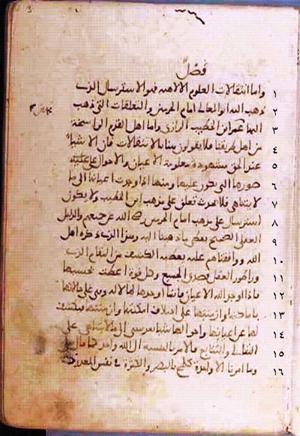
Section
As for transitions in the divine sciences, these are the uninterrupted extension maintained by Abu al-Maʿali, the Imam of the Two Sanctuaries, and the relations maintained by Muhammad ibn Umar ibn al-Khatib al-Razi. Those firmly established among the people of our path, however, do not speak of transitions here. For, with the Real, things are witnessed and known in their entities and states, in the forms in which and from which they will be when their entities come into existence, without end.
Thus no new relation arises, as in Ibn al-Khatib’s doctrine, nor is there an uninterrupted extension, as in the doctrine of the Imam of the Two Sanctuaries—may God be pleased with them all. Sound rational proof yields the position we hold. What the people of God have stated, and in which we agree with them, is given by unveiling from the station beyond the domain of reason. Thus all are true, and each faculty has given according to its capacity.
When God brings entities into existence, He brings them into existence for themselves, not for Himself. They are in their states, in their places and times, despite the differences among their places and times. He unveils to them their entities and states, one after another without end, successively and consecutively. In relation to God, the affair is one, as He says, exalted is He: “Our command is but one, like a glance of the eye” [al-Qamar 54:50]. Multiplicity lies in the numbered things themselves.
Notes
Translator’s note TN648-1: “Uninterrupted extension” renders istirsāl, and “relations” renders taʿalluqāt: here both concern how divine knowledge relates to its objects. The author contrasts accounts involving extension or newly arising relations with an all-encompassing knowledge for which succession belongs to what creatures experience.