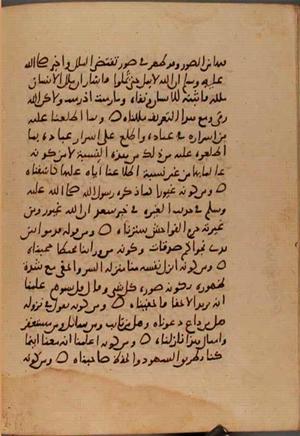
and He appeared in forms requiring weariness, while he, God’s blessings and peace be upon him, reported, “God does not grow weary until you grow weary,” indicating that the human being’s weariness is His weariness, affirming it of the human being and denying it: ﴿You did not throw when you threw, but God threw﴾ [The Spoils 8:17]—with this teaching, we made Him weary.
Through what He disclosed to us of His secrets within His servants, and His learning His servants’ secrets through their disclosing these to Him—from this relation, not from His knowing them apart from the relation of our disclosing them to Him—we exchanged disclosures with Him.
Insofar as He is jealous, as God’s Messenger, God’s blessings and peace be upon him, mentioned in the report of Saʿd on jealousy, that God is jealous and from His jealousy forbade abominations, we covered Him.
Through His saying, ﴿Present alms before your intimate converse﴾ [The Pleading Woman 58:13], and insofar as He encompasses us from behind, we veiled Him.
Insofar as He placed Himself in relation to us in the station of the secret and what is more hidden, despite His intense manifestation as the form of everything, and said, ﴿Say, “Name them”﴾ [Thunder 13:33], we knew He desired concealment, so we hid Him.
Insofar as He says in His descent, “Is there anyone calling?” we called Him. Through “Is there anyone repenting, asking, or seeking forgiveness?” and the like, we entered a mutual encounter with Him. Insofar as He made known that He is with us wherever we are, through witnessing and preservation, we accompanied Him.
Insofar as He
Notes
Translator’s note: The unvocalized verb can be read as malilnāhu, suggesting “we grew weary of Him,” while the causative mallalnāhu yields “we made Him weary.” The preceding identification of human and divine weariness informs the rendering.