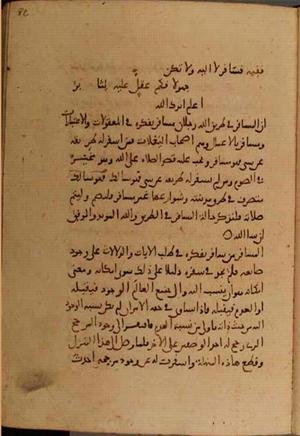
Travel within Him, not toward Him, and do not be
ignorant: many an intellect persists upon it.
Know, God strengthen you, that travelers on God’s path are of two kinds: one travels through thought among intelligibles and inward applications; the other travels through works, the people of the riding camels. Whoever has something unveiled to him by his path is a traveler. He must confine prayer to God and has a choice concerning fasting. Whoever has nothing unveiled to him by his path is a wayfarer moving along his city’s roads and streets, not a traveler: let him fast and complete his prayer. Let us mention the traveler’s state upon the path. God is the Strengthener and Granter of Success, God willing.
(Travel through Thought and Establishing the Maker)
The traveler is one who travels through thought seeking signs and indications of his Maker’s existence. In his travel he finds no proof of this except his own possibility. His possibility means that existence is ascribed to him and the whole world, and he admits it, or nonexistence is ascribed, and he admits it.
When the two matters are equal in his case, the ascription of existence to him in respect of his essence is no more fitting than the ascription of nonexistence. He therefore needs the existence of a determiner who determines one description for him over the other.
When he reaches this stopping place, crosses this watering stage, and it unveils for him his determiner’s existence, he begins
Notes
Translator’s note TN4858-1: Safar, ‘travel,’ is linked with asfāra, ‘to unveil/reveal.’ This verbal relation governs the distinction between traveler and wayfarer. The ‘riding camels’ renders yaʿmalāt, an image for those traveling through works. The preceding poem’s ʿalayhi, ‘upon it/Him,’ has no explicitly named antecedent in its line.
Translator’s note TN4858-2: Qaṣr al-ṣalāt ʿalā Allāh retains ‘to God.’ Qasr can denote confinement as well as a traveler’s ritual shortening of prayer; the passage places this together with the travel provisions concerning fasting.