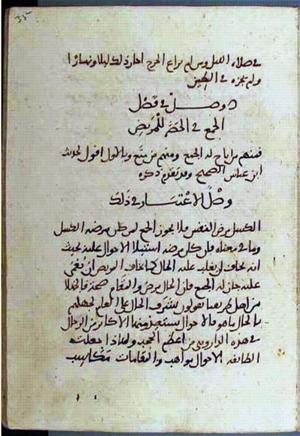
in the nighttime prayer. Those who do not take hardship into account allow combining by night and by day, but do not allow it on account of mud.
Continuation on the Section Concerning Combining While Resident for Someone Who Is Ill
Some allow him to combine, and some forbid it. I hold the first view on account of the sound hadith of Ibn ʿAbbās, which has already been mentioned.
Continuation on the Inward Application of This
Laziness is a sickness of the soul. Combining is therefore impermissible for someone whose illness is laziness or something akin to it.
If his illness is that spiritual states take possession of him, so that he fears being overcome by the state as someone who is ill fears fainting, he may combine. The state is illness, and the station is health.
(State, Knowledge, and Where Ascent Takes Place)
The ignorant among the people of our path say that the state is nobler than knowledge, because they do not know what the state is. The great among men seek refuge from states in this world. They are among the greatest veils. For this reason the community has regarded states as gifts and stations as acquisitions.
Notes
Translator’s note TN1964-1: A state (ḥāl) is a condition that may descend and overpower a person. A station (maqām) is an acquired degree of the path. The contrast between illness and health turns on that difference.