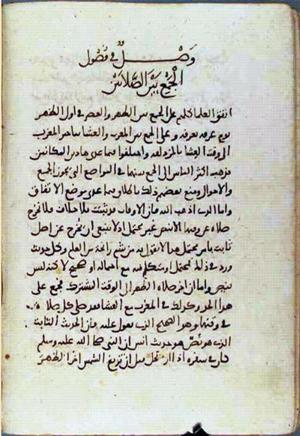
Continuation on the Sections Concerning Combining Two Prayers
All the scholars agree on combining the noon and afternoon prayers at the beginning of the time for the noon prayer at ʿArafah on the Day of ʿArafah, and on combining the sunset and night prayers at Muzdalifah by postponing the sunset prayer until the time for the night prayer.
They disagree about cases other than those two places. Most allow the two prayers to be combined in the places and circumstances in which combining is permitted. Some forbid it altogether outside the cases of agreement.
(Established Prayer Times and the Import of the Reports on Combining)
My position is that the times have been established without disagreement, so we may put a prayer outside its time only on the basis of an unambiguous text. A settled principle ought not be set aside on the basis of something open to interpretation. No one who has caught even a scent of knowledge says otherwise. Every hadith that has been transmitted on this is either open to interpretation, disputed as well as open to interpretation, or sound without being explicit.
If he postpones the noon prayer until the period common to both prayers and combines them in that manner, and likewise with the sunset and night prayers, he has performed each prayer in its own time. This is the sound position on which one may rely.
The established hadith that provides an explicit text is the hadith of Anas, that when the Prophet, may God bless him and grant him peace, was traveling and set out before the sun declined, he would postpone the noon prayer
Notes
Translator’s note TN1957-1: The report explicitly describes postponing the noon prayer. What remains open to interpretation is whether either prayer was performed outside its established time.