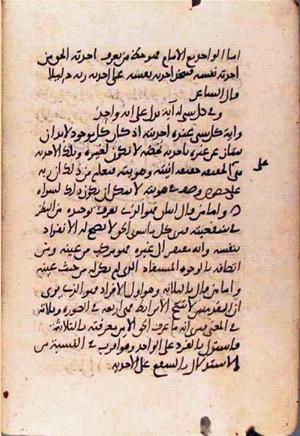
As for one person with the imam, that is the share of one who knows the oneness of the Real from the oneness of himself, taking his own oneness as a sign of his Lord’s oneness. As the poet says,
In everything He has a sign that shows that He is one.
The sign in each thing, for this person, is its oneness. Every existent thing must be distinct from others through a oneness peculiar to it that no other thing has. That oneness is truly the reality of its thatness and its identity. From this he knows that his Lord is distinguished by a description peculiar to His identity that can belong to no other.
The one who says two knows His oneness from considering the paired constitution of created things. He sees that everything besides the Real cannot subsist alone by itself and is in need of another. It is composed of its own entity and its possession of existence that it received and that did not belong to it by virtue of its own entity.
(Oddness and the Composition of a Proof)
The one who says three, the first of the odd numbers, holds that two premises yield a conclusion only by means of a connecting term. They are four in form and three in meaning[9]. Thus he sees that he knew the Real only through his knowledge of the three. He infers the One from the odd, which is closer in correspondence than inferring oneness from the even.
(The Appointed Term and Sincerity)
Notes
[9]
(The two premises have four places for words, but the connecting term recurs in both. The number of terms in meaning is therefore three.)
Translator’s note TN1909-1: “Thatness” renders anniyyah, here the fact of being that particular entity. Shafʿ and fard distinguish the even or paired from the odd. In the example from logic, the repeated middle term reduces four term positions to three distinct terms.