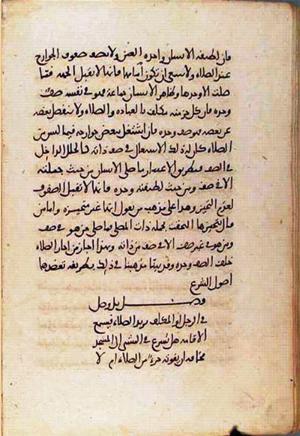
The human subtle reality is a single entity. It does not stand in the rows formed by the bodily members in prayer, and it cannot be before them, for it admits of no direction. It therefore prays alone.
Outwardly, the human being is a congregation. He constitutes a row in himself, since each part of him is charged with worship and prayer and none is separate from another. He is thus a row in himself. If he occupies some of his bodily members with something outside prayer, that occupation is like a gap opening in the row of his own being.
In the inward application, the human being considered as a whole prays only in a row, while his subtle reality prays alone. The subtle reality admits of no rows because it occupies no spatial position. This is the view of those who say it occupies no spatial position. On the view that it does, it belongs to the whole being of the worshiper. Thus both one who stands in a row and one who stands outside a row pray in a row composed of their own being. On this basis, some permit prayer alone behind a row. We have set out our view on the matter in a way supported by the principles of revealed law.
Section, or Rather, Continuation on Whether a Man, or Anyone Under Religious Obligation, Should Walk Quickly to the Mosque When He Intends to Pray and Hears the Summons to Begin, for Fear of Missing Part of the Prayer
Notes
Translator’s note TN1871-1: The subtle reality is the laṭīfa. The discussion considers whether it occupies a spatial position. On the view that it does not, the inward worshiper has no place in a row, even as the bodily members form a congregation.