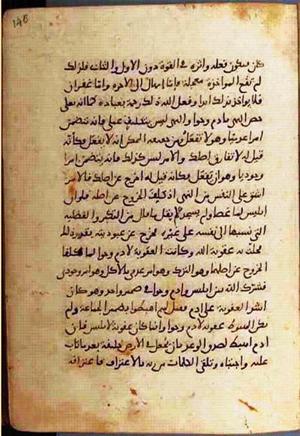
it may be. Its action and effect are therefore weaker than those of the first and second. For this reason accountability did not follow immediately: there is either a postponement until the Hereafter, or forgiveness, so that he is never called to account for it. God did this out of mercy toward His servants.
(The Origin of the Possible and the Difference between Command and Prohibition)
Likewise, He, exalted is He, singled out Adam and Eve for prohibition. Prohibition is not an obligation to act, for it contains a matter of nonexistence: “Do not do.” It belongs to the reality of the possible not to act, so it is as though he were told, “Do not depart from your origin.” Command is otherwise, for it contains a matter of existence: that he should act. It is as though he were told, “Depart from your origin.” Command is therefore harder upon the soul than prohibition, since it is charged with leaving its origin.
Had Iblis, when he disobeyed[63] and did not prostrate himself, not said what he said of arrogance and of the superiority he attributed to himself over another… Through that he departed from his servanthood to that extent, and God’s punishment descended upon him. The punishment of Adam and Eve came when they undertook to depart from their origin—abstention, a matter of nonexistence—through eating, a matter of existence.
(The Descent of Adam and Eve and the Descent of Iblis)
God combined Iblis, Adam, and Eve within a single pronoun, which was the severest punishment for Adam. They were told, “Descend” [al-Baqarah 2:36], with the plural pronoun. The descent itself was not a punishment for Adam and Eve; it was a punishment for Iblis. Adam was sent down to fulfil the true promise that He would place a vicegerent upon the earth, after He had turned toward him and chosen him, and after he had received words from his Lord through acknowledgment.
His acknowledgment
Notlar
[63]
(The source begins this conditional construction with “Had…”; it has been preserved without supplying a verbal completion or a conjectural correction.)