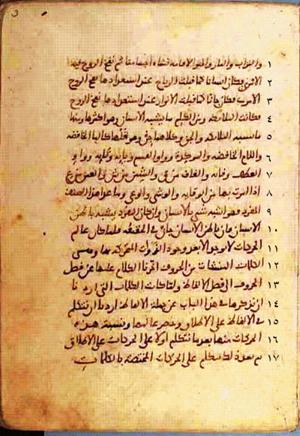
earth, fire, and air are the materials for establishing the formation of our bodies. Then the spirit belonging to the Command was breathed in, and a human being came to be. Likewise, when the winds were ready, they received the breathing-in of the spirit belonging to the Command, and a jinn came to be; and when lights were ready, they received the breathing-in of the spirit, and angels came to be.
(The Resemblance of Words to Humans, Jinn, and Angels)
Some words resemble human beings, and these are the majority. Others resemble angels and jinn—both of which are jinn[6]—and these are the minority. Examples are the bā that governs the genitive; lām governing the genitive or expressing emphasis; the wāw, bā, and tā of an oath; the wāw and fā of conjunction; and qāf in qi, shīn in shi, and ʿayn in ʿi, when you use them as commands derived from protection, embroidery, and retaining in mind.[7] Apart from this class of single letters, words most closely resemble the human being. Yet the single letter resembles the human being’s inward dimension, for inwardly the human being is in reality a jinn.[8]
(Utterances)
Since the world of vowel movements exists only after the essences moved by them—that is, the words formed from letters—have come into existence, we have postponed their discussion from the section on letters to the section on utterances.
Since the words we intend to discuss in this chapter are among utterances as a whole, we intend to discuss utterances without restriction, the delimitation of their world, and the relation of these vowel movements to them. First, however, we shall discuss movements without restriction; afterward we shall discuss the vowel movements particular to words—
Notlar
[6]
[The source contains only the unintelligible repeated letters, transliterated: blblblblblblblbl.]
[7]
From washā, yashī, washyan; washy is the ornamentation of cloth. Imperative verbs consisting of one letter:
Twenty imperative verbs consist of one letter. All bear kasrah, except ra, from raʾā, yarā, and warā, yarī, which bears fathah. The scholar Ahmad Taymur Pasha, who died in 1348 AH, mentioned this in al-Mukhtarat.
They are:
1. ʾi, from waʾā, yaʾī, waʾyan; waʾy means a promise.
2. Ti, from atā, yaʾtī, atyan, utiyyan, itiyyan, ityānan, ityānatan, and maʾtātan; that is, “I came to him.” Some Arabs use iʾti in the imperative, and most people give the command with iʾti, not ti!
3. Thi, from wathā, yathī; that is, he informed against someone to the ruler.
4. Ji, from wajā, yajī; that is, he cut. As for wajā, it means soreness from walking barefoot.
5. Ḥi, from waḥā, yaḥī, waḥyan; waḥy means signalling, writing, and speech.
6. Khi, from wakhā, yakhī, wakhyan; that is, he aimed at something.
7. Di, from wadā, yadī, wadyan; that is, he paid blood money.
8, 9. Ra: (a) from raʾā, yarā, al-hilāl, ruwyatan, raʾyan, and rāʾatan: he saw the crescent.
(b) From warā, yarī, al-qayḥu jawfahu, waryan: pus spoiled his interior.
10. S [the vowel is not marked in this entry], from wasā, yasī: “Zayd shaved Amr’s head,” wasyan—that is, he shaved it.
11. Shi, from washā, yashī, washyan; washy means the ornamentation of cloth.
12. Ṣi, from waṣā, yaṣī, waṣyan: he joined one thing to another.
13. ʿi, from waʿā, yaʿī, waʿyan; that is, he retained and gathered.
14. Fi, from wafā, yafī, wafāʾan, meaning the fulfilment of a covenant.
15. Qi, from waqā, yaqī, waqyan, wiqāyatan, and wāqiyatan, meaning preservation. The initial wāw of wiqāyah may bear any of the three vowels.
16. Ki, from wakā, yakī, al-qirbah: he tied the waterskin. Wikāʾ is the tie of a waterskin or similar object.
17. Li, from walā, yalī, wilāyatan; wilāyah means governance.
18. Mi, from wamā, yamī, wamyan: he signalled.
19. Ni, from wanā, yanī, wanyan and wināʾan; that is, he grew tired.
20. Hi, from wahā, yahī, wahyan; that is, he became weak.
[See Lijam al-Aqlam by Abu Turab al-Zahiri, vol. 1, p. 49.]
[8]
[The source contains only an unintelligible letter sequence, transliterated: b-th-ṣ-b-th-ṣ-b.]
Translator’s note TN326-1: The examples qi, shi, and ʿi mean “protect!”, “embroider!”, and “retain!” They each consist of one consonant carrying a short vowel. The broader use of jinn here stresses concealed or inward reality, while retaining the author’s distinction between angels and other jinn. The verbal forms and unusual readings in note 7 are retained from the supplied list rather than normalized to a different grammatical account.