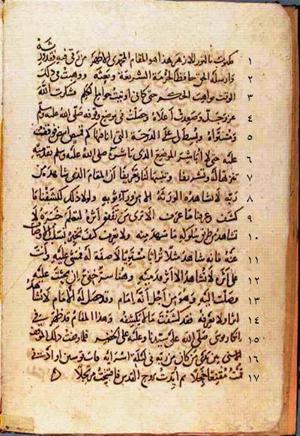
was written in radiant light: “This is the most pure Muhammadan station. Whoever ascends it has inherited it, and the Real has sent and commissioned him to safeguard the sanctity of the revealed Law.”
At that moment, gifts of wisdom were bestowed upon me, as though I had been given all-comprehensive speech.[30] I thanked God, mighty and majestic, climbed to its highest step, and reached the place where he—may God bless him and grant him peace—had stood.
Upon the step where I stood,[31] the sleeve of a white shirt was spread for me, and I stood upon it, so as not to touch directly the place his feet had touched. This was to exalt and honour him, and to alert and instruct us that the station he witnessed from his Lord is witnessed by the heirs only from behind his garment.
Were it otherwise, we would unveil what he unveiled and know what he knew. Consider someone whose tracks you follow in order to learn of him: you do not witness of the path he travelled what he witnessed of it, nor do you know how to speak of it as devoid of attributes. For example, he saw level earth with no distinguishing mark and walked upon it; following his tracks, you see only his footprints.
Here lies a hidden secret: if you investigate it, you will reach it.[32] Because he is the leader and has gone ahead, he witnesses no footprint and does not know it; you have thus unveiled what he does not unveil!
This station appeared in Moses’s objection—may God bless our master and him—to al-Khidr (as their story is related in Surat al-Kahf [Qur’an 18:60–82]).
When I stood in that most exalted place before the one who, on the night of his journey, was two bow-lengths or nearer from his Lord [Qur’an 53:9], I stood with my head raised, abashed. Then I was strengthened by the Holy Spirit and began to recite extemporaneously:
Notlar
[30]
“The meaning of all-comprehensive speech.” [This is an unfinished note heading in the source.]
[31]
The reports mentioned above state that the tamarisk pulpit—the pulpit of Muhammad, may God bless him and grant him peace—had three steps, and that the Prophet stood upon its third step.
[32]
Perhaps he is referring to the fact that we can know God only through His creation—that is, through the acts of His Most Beautiful Names and Attributes. We therefore do not know Him with complete knowledge through the total negation of attributes, because we have seen only His acts and noble Attributes, which are His manifestations and self-disclosures. The Prophet—may God bless him and grant him peace—however, is, as indicated above, the Perfect Human, the Manifest Imam, the Single Monad, the First Intellect, and the Supreme Pen through whom God created the cosmos. He thus has a special face toward his Creator. This is the meaning of the saying attributed to him: “I have a time with God in which neither an angel brought near nor a messenger-prophet can encompass me.” Sufis frequently cite this report, and Ibn al-Arabi alludes to it in his litanies. It does not occur in the hadith books in this wording, but something close to it is related by al-Tirmidhi in his Shamail and Ibn Rahawayh in his Musnad, from Ali: when the Prophet entered his home, he divided his time into three portions—one for God, one for his family, and one for himself; then he divided his own portion between himself and the people. See al-Ajluni, Kashf al-Khafa, hadith no. 2159. From that special face, the Prophet knows God not through His acts, Names, and Attributes relating specifically to creation, but through His Essence—though not through the perfection of His Essence, but through its beauty, or the perfection of its beauty, glory and exaltation be to Him. He does not know Him through the perfection of perfection, in which God does not disclose Himself to any creature. We, however, know God only through His Attributes, which are merely forms or traces of this First Universal Intellect, whose practice and path we secondary, particular intellects follow.
Translator’s note TN9-1: All-comprehensive speech (jawami al-kalim) denotes concise expression encompassing many meanings. Numbered note 30 is only an unfinished heading in the Arabic source.
Translator’s note TN9-2: The footprint example distinguishes the leader’s direct encounter from the follower’s encounter with its traces. The follower sees something additional—the footprint—without thereby acquiring the leader’s original mode of witnessing.