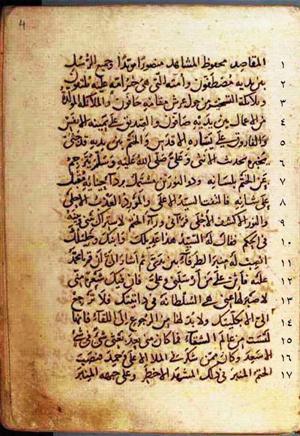
protected in his purposes, safeguarded in his visions, victorious and supported, all the messengers stood arrayed before him. His community—which is the best community [Qur’an 3:110]—surrounded him. The angels entrusted with governing creation encircled the throne of his station, and the angels generated by deeds stood in ranks before him.[22]
Al-Siddiq (Abu Bakr) stood at his most precious right hand, and al-Faruq (Umar) at his most holy left. The Seal[23] knelt before him, telling him the account of the female.[24] Ali—may God bless him and grant him peace—spoke for the Seal in his own tongue, while the Possessor of the Two Lights (Uthman, may God be pleased with him), wrapped in the mantle of his modesty,[25] attended to his task (in serving God’s Messenger, may God bless him and grant him peace).
The highest master, the sweetest source of fresh water, the most revealing and radiant light, turned and saw me behind the Seal, because he and I shared a certain ruling.[26]
The master said to him: “This is your counterpart, your son, and your intimate friend. Set up for him the pulpit of tamarisk[27] before me.”
Then he gestured to me: “Rise upon it, Muhammad,[28] and praise the One who sent me, and praise me. Within you is a hair of mine (the rational soul),[29] which cannot bear separation from me. It is the sovereign within your selfhood, and it shall return to me only with your entirety (or: you shall return to me only with your entirety).
“It must return to the encounter, for it does not belong to the world of wretchedness. Since my being sent, no part of me has been present in anything without that thing attaining felicity and becoming one of those thanked and praised in the Highest Assembly.”
(His Address to This Spiritual Gathering)
The Seal set up the pulpit in that momentous scene. On the face of the pulpit—
Notlar
[22]
This alludes to the report in which God’s Messenger—may God bless him and grant him peace—said: “My life is good for you, and my death is good for you. In my life, I establish practices for you and lay down laws for you. As for my death, your deeds are presented to me: whatever good I see in them, I praise God for it; whatever evil I see, I ask God’s forgiveness for you.” In his documentation of the reports in the Ihya (vol. 4, Book of Patience and Gratitude, hadith no. 5), al-Iraqi says that al-Bazzar transmitted it from Abd Allah ibn Masud, and that its transmitters are transmitters of the Sahih.
[23]
This is Jesus, peace be upon him, because, as Ibn al-Arabi says, he is the Seal of Universal Sainthood, whereas Ibn al-Arabi is the Seal of Muhammadan Sainthood. We shall return to this later; see also Shams al-Maghrib, pp. 172 and 270.
[24]
Perhaps by “the female” he means the earth or the body, the locus acted upon by the spirit—that is, Jesus, peace be upon him, who is the Seal. God knows best, and He is the Knower of unseen things.
[25]
Khalid al-Hadhdha al-Basri reported from Abu Qilabah al-Basri, from Anas, that God’s Messenger—may God bless him and grant him peace—said: “The most merciful of you is Abu Bakr; the firmest of you in religion is Umar; the most accomplished in Qur’anic recitation is Ubayy; the truest in modesty is Uthman; the most knowledgeable concerning the lawful and unlawful is Muadh ibn Jabal; and the most knowledgeable in inheritance shares is Zayd ibn Thabit. Every community has a trustee, and the trustee of this community is Abu Ubaydah al-Jarrah.”
[26]
Jesus, peace be upon him, is the Seal of Universal Sainthood, so there is no saint after him. This will occur when he descends before the Day of Resurrection in the protected city of Damascus. Ibn al-Arabi, however, is the Seal of specifically Muhammadan Sainthood; this is what they share. “The Seal of Muhammadan Sainthood” means that saints are the heirs of prophets, and every saint must therefore be upon the heart of a prophet—that is, upon his footing or following his trace. Some are upon the heart of Moses, some upon that of Jesus, and some upon those of other prophets—God’s blessings and peace be upon them all. Others are upon the heart of Muhammad, may God bless him and grant him peace, although all draw exclusively from the revealed Law of the Seal of the Prophets, Muhammad. Ibn al-Arabi is the Seal of Muhammadan saints: after him there is no complete heir of the Prophet. “Inheritance” here means inheriting something particular to the Prophet Muhammad—that is, something in his revealed Law that was not present with the other prophets. For more on inheriting from the prophets, see Shams al-Maghrib, p. 110. On the sealing of universal and particular sainthood, and on Ibn al-Arabi as the Seal of particular sainthood, see Shams al-Maghrib, p. 271.
[27]
A fine kind of tree in the tamarisk family (Tamaricaceae), reaching two metres in height, with branching woody stems, light-green needle-like leaves, pink flowers, and pink cone-shaped fruits. God’s Messenger—may God bless him and grant him peace—had his pulpit made from it, as related in Sahih al-Bukhari, Sahih Muslim, and elsewhere. See, for example, Sahih al-Bukhari, vol. 1, Book of Friday Prayer, chapter on delivering the sermon from the pulpit, hadith no. 875.
[28]
Ibn al-Arabi’s name is Muhammad ibn Ali ibn Muhammad ibn Ahmad ibn Abd Allah al-Hatimi al-Tai. See Shams al-Maghrib, p. 13.
[29]
This is the soul that God addresses upon lifting the veils, as He says in Surat al-Fajr (89): “O soul at peace [27], return to your Lord, pleased and pleasing [28]. Enter among My servants [29], and enter My Garden [30].” For more on the soul’s degrees and ranks, see Chapter Three of Suluk al-Qalb, pp. 129–144, which is Chapter Two in the forthcoming new edition ??? [The source leaves this publication reference unfinished.]
Translator’s note TN8-1: “The Seal” is a technical spiritual title. The identification with Jesus and the distinction between universal and Muhammadan sainthood are supplied by the Arabic editor in notes 23 and 26. Note 24 presents its interpretation of “the female” only as a possibility.
Translator’s note TN8-2: “Rational soul” translates al-nafs al-natiqah, the intellective or articulating soul; the expression does not refer merely to everyday reasoning. The source itself identifies the symbolic “hair” with this soul.