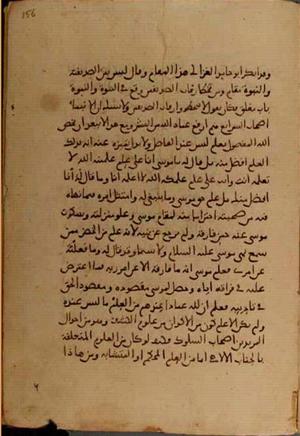
Abu Hamid al-Ghazali denied this station and said, “There is no station between utter truthfulness and prophethood.” Whoever steps over the necks of the utterly truthful falls into prophethood, and prophethood is a closed door. He therefore used to say, “Do not step over the necks of the utterly truthful.”
There is no doubt that the prophets who possess revealed laws are the highest of God’s human servants. Yet it is not unlikely that God should particularly give one of lesser excellence knowledge absent from one of greater excellence. His being distinguished by that knowledge does not show that he is thereby more excellent.
Rather, he told him, “Moses, I possess knowledge God taught me that you do not know, and you possess knowledge God taught you that I do not know.” He did not say, “I am more excellent than you.” He knew Moses’ due and what befitted him and complied with his command forbidding their companionship, out of respect for Moses’ station and lofty rank.
Moses remained silent concerning him when he parted and did not retract his prohibition, for he knew concerning al-Khidr [that he was] among those who had heard Moses’ prohibition[82], peace be upon him. Especially since he had said to him, “I did not do it by my own command” [al-Kahf 18:82], Moses knew he parted from him only by his Lord’s command and did not object to his parting.
Moses attained his purpose and the Real’s purpose in educating him. He knew that God has servants possessing knowledge he does not possess. This was only knowledge of one created thing among created things, from the knowledges of unveiling, belonging to the states of aspirants who travel the path. How much more had it been knowledge concerning the divine side, whether unambiguous or ambiguous?
(The Secret and Steadfastness of al-Siddiq)
From this
Notlar
[82]
(The passage was compared with the image of the newer edition, p. 443, and «لأنه علم من الخضر ممن سمع نهي موسى» was restored. This is its established reading, replacing «إن الخضر ممن لم يسمع», “al-Khidr was among those who had not heard.”)
Translator’s note TN4374-1: The restored clause about Moses’ prohibition remains grammatically compressed. The bracketed link construes it as Moses knowing that al-Khidr had heard his prohibition; it retains the positive samiʿa, ‘heard,’ and does not adopt the replaced negative reading. Muḥkam and mutashābih in the final question are rendered unambiguous and ambiguous, preserving the technical contrast.