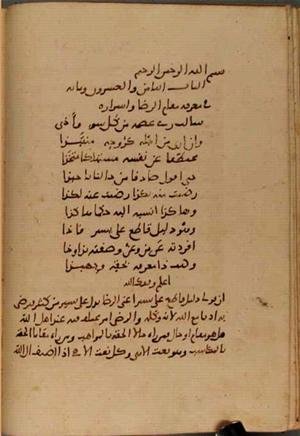
In the name of God, the All-Merciful, the Most Merciful.
Chapter One Hundred and Twenty-Eight: Knowing the Station of Satisfaction and Its Secrets
I asked my Lord for protection
from every evil and harm,
and that, for His sake, I be seen
withdrawn, like His spirit,
snatched away from himself,
consumed and taken,
until I say truthfully
of our state: How excellent!
I am satisfied with such from Him;
I am satisfied with Him for such.
Thus I attribute it
to Him as a ruling, thus.
It is a decisive proof
of a little. Then, when
you strip it of “from” and “with,”
you describe Him by this and that,
being one possessing knowledge
of His right, an expert.
Know—may God grant you success—that by my saying “a decisive proof of a little” I mean satisfaction. It indicates a little out of much, with which one is satisfied out of courtesy toward God, for he has entrusted Him.
(Satisfaction between Station and State)
The people of God disagree over satisfaction: is it a station or a state? Whoever regards it as a state places it among gifts, and whoever regards it as a station places it among acquisitions. It is a divine description. When any divine description is attributed to God,
Notlar
Translator’s note TN4163-1: The poem distinguishes riḍā minhu, satisfaction with what comes from Him, from riḍā ʿanhu, satisfaction with Him. “From” and “with” retain those two relations. The supplied wa-in arā is read as continuing the request, “and that I be seen”; a conditional “and if I am seen” is also possible. The opening image of withdrawal “like His spirit” and the passive forms of being snatched, consumed, and taken are not expanded with unstated referents. The final “he has entrusted Him” has compressed pronominal reference in the source.