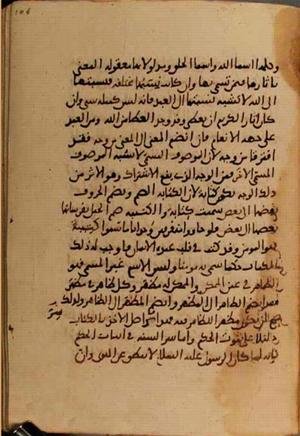
All are God’s names and creation’s names. Their indications are intelligible through their effects in those named by them, although their relations differ. Their relation to God does not resemble their relation to the servant, for “Nothing is like His likeness” [al-Shura 42:11]. Although giving is an effect of the Generous, and giving as a favor is found from God and the servant, if meaning joins meaning in one respect, they differ in another, for the described bearer of one name does not resemble the other described bearer.
From the respect in which sharing occurs, namely the effect, it is writing, for writing is joining. Letters’ being joined to one another is called writing. A battalion is horses and their horsemen joined to one another; were they to come separately, one by one, they would not be called a battalion.
He is the Faithful, and He inscribed faith in His servant’s heart. That writing entails a ruling for him through which he is called a believer. The name is not other than the named. He is thus manifest within the possible entity, and the possible thing is His locus of manifestation. Whatever is manifest within a locus of manifestation, the manifest is joined to the locus and the locus to the manifest. Through this it may rightly be a locus of manifestation for what is manifest within it. This is the secret of the principle of adopting the Book as evidence for establishing a ruling.
(The Secret of the Sunna)
As for the Sunna’s secret in establishing the ruling, since the Messenger, peace be upon him, does not speak from caprice, and
Notlar
Translator’s note TN3966-1: The wordplay joins kitāb, “Book,” kitāba, “writing,” and katība, “battalion,” through the stated meaning of joining.
Translator’s note TN3966-2: Al-Muʾmin is rendered “the Faithful” for the divine name and “a believer” for the servant. The same Arabic form underlies both, linked here through īmān, faith, inscribed in the heart.