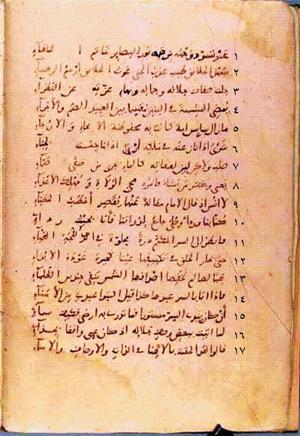
“A servant whose face has darkened from his concern,
The light of inner sight, the Seal of the successors;
“Gentle in character, good, sweet in fruit,
The Succour of creatures,[89] most merciful of the merciful;
“His attributes of majesty and beauty, and the splendour
Of his might, are exalted above all peers.
“He carries out the Will among the sons, apportioning
Between the deaf servants[90] and the hired workers.
“He has ever governed a community whose quarters
And borders are preserved through him.
“Bitter colocynth if you contest his kingdom,
Honey if you come to him for a gift;[91]
“Firm, yet gentle toward those who seek his bounty,
Like water flowing from solid rock;
“He enriches and impoverishes whom he wills;
His command gives life to the governors[92] and destroys the enemies.”
I do not forget when the Imam spoke words
Before which the most eloquent speakers fall short:
“We were through ourselves, while the mantle of my union gathered
Our selves together; I am wherever my mantle is.”
Look upon the closely guarded secret as a pearl
Polished within the sightless depths,
Until creatures are bewildered about its actual manner of being,
As they are bewildered by the return of the beginning.
How wondrous that its shells have not concealed it!
The sun dispels the blackness of darkness.
When a servant brings forth the secret in this manner,
It is said: “Inscribe My servant among the trustworthy.
“If he reveals the secret while keeping it veiled,
My earth knows nothing of it—how then My heaven?”
When I brought forth some description of his Majesty,
For he was my very entity, standing beside me,
They said: “You have equated him with our God
In Essence, Attributes, and Names—
Notlar
[89]
The first khala iq is the plural of khuluq, character; the second is the plural of khalq, creature. The Succour, al-Ghawth, is the Pole. There is only one in each age: the Real singles him out and is alone with him apart from creation. He is among those brought near, and is the leader of the company in his time. In Chapter Seventy-Three, Ibn al-Arabi says that some Poles exercise outward authority and possess the outward caliphate as well as the inward caliphate through their station—for example, Abu Bakr, Umar, Uthman, Ali, al-Hasan, Muawiyah ibn Yazid, Umar ibn Abd al-Aziz, and al-Mutawakkil. Others possess only the inward caliphate and have no outward authority, such as Ahmad ibn Harun al-Rashid al-Sabti and Abu Yazid al-Bistami. Most Poles have no outward authority. See also Shams al-Maghrib (p. ??? [reference unfinished]).
[90]
Perhaps by “deaf servants” he means those who do not listen to the insinuations of Satan and the lower self. They therefore see no merit of their own in obedience and good works, and seek no wage for them. This contrasts with hired servants, who work out of desire for God’s recompense and reward.
[91]
Shary is colocynth, and ary is the work of bees, honey. Something with two tastes is thus described as ary and shary. Hiba is what a person bestows upon his companion to honour him; it is connected with ihtiba, and may also be pronounced huba.
[92]
That is, he gives life to the hearts of the saints, since he is the Pole and Succour. I heard the distinguished Shaykh Ramadan Subhi Dib, one of the eminent scholars of Damascus, relate that his shaykh, the distinguished Shaykh Ahmad Amin Kuftaro—may God have mercy upon him—the leader of the Naqshbandi path in Syria, said: “I am the money-changer of the saints. I test people upon my touchstone: some are counterfeit and contain no good, while others are assayed as pure; and one such as I is qualified to assay them.” Bahraj means a counterfeit dirham plated with silver.