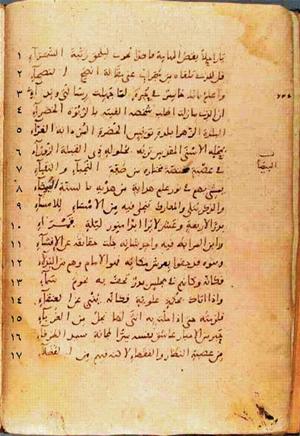
traveller crossing the trackless wastes, making for me
To attain the rank of companions in nocturnal conversation:
Tell whichever of my intimates you meet,
On my behalf, the words of the most sincere adviser.
Know that you are at a loss, bewildered,
So long as you are ignorant of my message and my call.
The man whose person I had continually sought[79]
I found upon the green hill,
In the radiant city, the city of Tunis,
Green, adorned, and splendid,
At his most exalted dwelling, whose soil is sanctified[80]
By his presence, with its turning qiblah,
Among a specially chosen, elect company
From the ranks of the Noble Ones and the Chiefs.
He leads them in the light of guiding knowledge,
Through his guidance by the luminous Sunnah.
Remembrance is recited and recognitions are unveiled
There from evening to evening.
A full moon of the fourteenth night, never seen
Illuminating a moonlit night.
There Ibn al-Murabit[81] is unique in his affair;
His realities are too exalted to be divulged.
His sons[82] surround the throne of his place;
He is the leader, and they are among the Substitutes (Budala).[83]
In their assembly, he and they resemble
A full moon surrounded by the stars of heaven.
When he brings you a wisdom from on high,
It is as though he speaks of the Anqa.[84]
I remained with him until there came to him
A woman with a son among the strangers:[85]
A learned man among the learned, in love with himself,
The secret of playful audacity,[86] a master of wit,
Of the company of speculative thinkers and jurists,
Yet among their distinguished men.[87]
Notlar
[79]
Perhaps he is referring to his shaykh and companion, Shaykh Abu Abd Allah ibn Khamis al-Kinani, who was also the shaykh of his companion Abd al-Aziz al-Mahdawi, to whom he addressed this poem. On Shaykh Muhyi al-Din’s relationship with al-Kinani and al-Mahdawi, see Shams al-Maghrib, p. 166.
[80]
This is the place known as Marsa Abdun, a well-known place frequented by Sufis, who kept spiritual vigil there. See also Shams al-Maghrib, p. 166.
[81]
This is Abd Allah ibn al-Murabit, who accompanied Shaykh Muhyi al-Din during his stay in Tunis in 590 AH/1195 CE [the date pair is retained as supplied].
[82]
His pupils or disciples: the pronoun refers to Shaykh al-Kinani. This is spiritual sonship, for they gathered around him in Tunis at Marsa Abdun.
[83]
The Budala are a class of saints, like the Abdal and the Pegs. Shaykh Muhyi al-Din discusses them in Chapters Sixteen and Seventy-Three of this book. They are twelve persons at every time—women may be among them—neither increasing nor decreasing in number. They are distinct from the Seven Abdal. They are called Budala because, if the others did not exist, any one of them could take their place and accomplish what all of them accomplish. Each one is thus the very whole, and it is no strange thing for God to gather the cosmos in one person.
[84]
The Anqa is a bird whose existence the Arabs asserted in their marvellous legends. Its story became proverbial for anyone speaking of something unknown to people. For Ibn al-Arabi here, it symbolizes the Dust, or the Reality of Realities, which is neither existent nor nonexistent. We discussed it in Chapter One of Nazariyyat al-Jawhar al-Fard (p. ??? [reference unfinished]).
[85]
An allusion to the Prophet’s saying, may God bless him and grant him peace: “Blessed are the strangers! Blessed are the strangers!” He was asked: “Who are the strangers, Messenger of God?” He replied: “A few righteous people among many evil people; those who disobey them are more numerous than those who obey them.” See Kanz al-Ummal, no. 16638.
[86]
Majana, yamjunu, mujunan, majanatan, and muj nan. Ibn Manzur says in Lisan al-Arab: “A thing majana, yamjunu, mujunan when it became hard and thick. Hence the derivation of majin, because of the hardness of his face and his lack of modesty … Among the Arabs, a majin is someone who commits ruinous ugliness and shameful scandals, unmoved by the reproach of those who blame him or the rebuke of those who censure him. Majn is mixing seriousness with jest.”
[87]
Perhaps he is referring here to the philosopher Abd Allah ibn al-Kattani. Although it is known that he met him in Fez in 591 AH/1195 CE, immediately after his first journey to Tunis, it is not impossible that they had met earlier in Tunis. See Shams al-Maghrib, p. 183.
Translator’s note TN21-1: The image of a fourteenth-night full moon “never seen illuminating a moonlit night” is translated as supplied; the construction is difficult and is not silently emended. “The turning qiblah” also retains the unusual qualifier in the Arabic rather than identifying a physical direction.
Translator’s note TN21-2: The personal identifications in notes 79 and 87 are expressly tentative in the Arabic editor’s commentary. The “woman” and her “son” are not given a more specific identity in the translation.