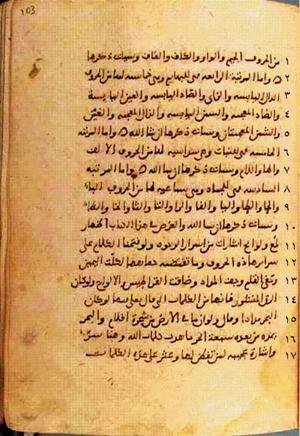
jīm, wāw, kāf, and qāf. They will be discussed.
The fourth rank belongs to the beasts. It is fivefold, and its letters are undotted dāl, zāy, undotted ṣād, undotted ʿayn, dotted ḍād, undotted sīn, dotted dhāl, and the dotted letters ghayn and shīn. They will be discussed, God willing.
The fifth rank belongs to plants. It is sixfold, and its letters are alif, hā, and lām. They will be discussed, God willing.
The sixth rank belongs to inanimate things. It is sevenfold, and its letters are bā, ḥā, ṭā, yā, fā, rā, tā, thā, khā, and ẓā. They will be discussed, God willing.
(Conclusion: The Vastness of Knowledge through Tasting)
The aim of this book is to disclose flashes and glimmering indications of the secrets of existence. Were we to open a discussion of the innermost secrets of these letters and what their realities entail, the right hand would weary, the pen would wear down, the ink would run dry, and the sheets and tablets would prove insufficient—even if they were the outspread parchment. For these belong to the words concerning which God says: “If the sea were ink for my Lord’s words, the sea would be exhausted before my Lord’s words were exhausted, even if We brought its like as replenishment” [Qur’an 18:109]. And He says: “If all the trees on earth were pens, and the sea were replenished after it by seven seas, God’s words would not be exhausted. God is indeed Mighty, Wise” [Qur’an 31:27].
Here lies a secret and a wondrous indication for whoever notices it and discovers these words:
Notlar
Translator’s note TN206-1: The source uses “dry” (yabisah) for several undotted letters, in contrast with letters marked by dots. “Undotted” conveys that orthographic distinction here. The numerical ranks are preserved as given; they are not replaced by counts of the letters listed in each class.