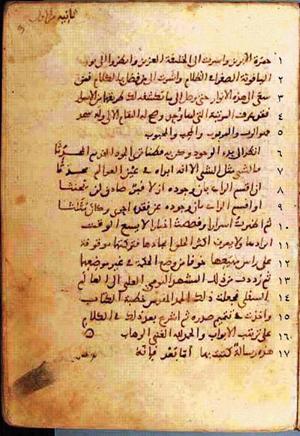
the redness of pure gold[62]—I pointed to David, peace be upon him, the mighty vicegerent.[63] Look at the light of the yellow ruby in the darkness—I pointed to Moses, blessings and peace be upon him, who was favoured with divine speech.[64]
Whoever strives toward these lights until he reaches the secrets their path unveils has known the rank for which he was brought into existence. The station of lordship[65] is established for him, and to it he prostrates himself. He is lord and subject to lordship, lover and beloved:
Look upon the beginning of existence and attend to it;
You will see beginningless generosity newly brought forth.
A thing is like a thing, except that He
Displayed it newly originated within the worlds.
If the beholder swears that its existence
Is beginningless, he is truthful and will not break his oath.
Or if the beholder swears that its existence
Follows its absence, that is more fitting; and it was threefold.
Then I disclosed secrets and related accounts that there is no time to set down, and whose bringing into being most creatures do not know. I left them waiting at the entrance to their broad path,[66] fearing to place wisdom where it does not belong.
Then I was returned from that exalted dream-vision to the lower world. I made that sanctified praise the preface to the book, and began completing its opening, after which I would proceed to discuss its chapters in order. Praise belongs to God, the Self-Sufficient, the Bestower.
(A Letter to His Companion, Shaykh Abd al-Aziz al-Mahdawi)
This is a letter[67] I wrote. To proceed:
Notlar
[62]
Ibriz is pure gold.
[63]
Perhaps he is pointing to our master David, peace be upon him, from His saying in Surat Sad (38): “David, We have made you a vicegerent upon the earth, so judge between people with truth and do not follow desire, lest it lead you astray from God’s path …” [38:26].
[64]
This is Moses, peace be upon him, from His saying in Surat al-Nisa: “… God spoke to Moses directly” [4:164].
[65]
Ill: lordship, kinship, good origin, and source or substance (al-Sahib ibn Abbad, al-Muhit fi al-Lughah, p. 966, al-Warraq ??? [reference unfinished]). Here, then, it is the station of lordship. … Kitab al-Tanazzulat al-Mawsiliyyah [the source leaves the remainder of this note unfinished].
[66]
Mahyaʿ means broad and clear. Ibn Manzur says in Lisan al-Arab: “Hiʿtu, ahaʿu, hayʿan, from love and grief. Land described as hayʿah is wide and spread out. A thing haʿa, yahiʿu, hiyaʿan when it expanded and spread. A road described as mahyaʿ is clear, broad, and evident; its plural is mahayiʿ.”
[67]
Many researchers suggest that these Meccan Revelations may originally have been merely a letter from Shaykh Ibn al-Arabi to his companion Abd al-Aziz al-Mahdawi in Tunis, whom he visited in 590 AH/1194 CE and in 597 AH/1201 CE on his way to Mecca. Uthman Yahya also suggested this in his study classifying Shaykh Muhyi al-Din’s works. Yet this conflicts with the facts, because the Shaykh, may God be pleased with him, explains in the first chapter that he received the book from the spirit he met while circumambulating the honoured Kaaba. It appears, rather, that he added this letter to the book’s preface—which he himself does not count as part of the book, as he explained at its beginning—because of its relevance in telling his companion what he had attained upon arriving in honoured Mecca. For more, see the study of al-Futuhat al-Makkiyyah in the introduction to this edition.
Translator’s note TN18-1: The final verse’s phrase “and it was threefold” is compressed and its referent is not made explicit. It may be read alongside the preceding discussion of two premises and their result, but the translation retains the phrase without making that connection definitive.