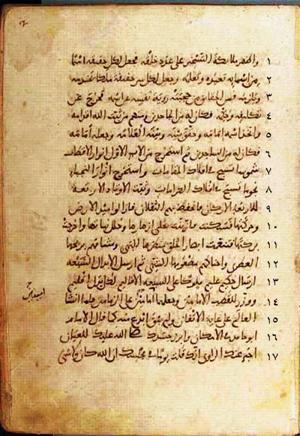
and manifested the angels entrusted with governing creation according to the number of His creatures. To each reality He assigned one of His Names, which it worships and knows; and to the secret of each reality He assigned an angel that serves it and remains with it.
Some realities were veiled from their Name by seeing themselves, and so departed from its obligation and ruling, becoming deniers of it. Others had their feet made firm by God, took their Name as their leader, realized the distinguishing sign between themselves and it, and set it before them: they became those who prostrate themselves to it.
Then (God) drew from the First Father (the First Intellect, or Universal Spirit—that is, the prophetic light, the light of our master Muhammad, may God bless him and grant him peace) the lights of the Poles, as suns swimming in the spheres of spiritual stations. He drew forth the lights of the Noble Ones as stars swimming in the spheres of charismatic gifts. He established the Four Pegs for the four corners, and through them preserved the two weighty kinds, humankind and jinn. They removed the earth’s swaying and motion, so that it became still,[46] adorned itself with the jewels of its flowers and the robes of its vegetation, and brought forth its blessing.
Creatures’ eyes delighted in its beautiful appearance, their nostrils in its fragrant scent, and their palates in its delicious food.
Then, as One wise and knowing, He sent forth the Seven Substitutes (Abdal) as kings over the seven regions, one Substitute for each region. He appointed the Two Imams as ministers to the Pole, making them leaders over the two reins.[47]
(The Temporal Origination of the Cosmos)
When (God) had brought forth this cosmos with the utmost perfection, so that—as Abu Hamid said—nothing more wonderful remained within possibility,[48] and had brought your body, blessings be upon you, into visible appearance, the transmitter reported that you said one day in your assembly: “God was, and nothing—
Notlar
[46]
An allusion to His saying in Surat al-Nahl (16): “He cast firm mountains into the earth lest it sway with you, and rivers and paths, that you might be guided” [16:15]; also Surat al-Anbiya 21:31 and Surat Luqman 31:10 [the surah and verse numbers are transposed in the supplied note]. Among the meanings of “earth” here is the body, and of “mountains,” the bones. Another meaning is creation generally, with the mountains signifying the Pegs—the four specially designated saints. Shaykh Muhyi al-Din discusses the ranks of the saints in detail in Chapter Seventy-Three of this book. For more on this, and on the Pegs and their relation to mountains, see also Shams al-Maghrib, p. 101.
[47]
Perhaps by “the two reins” he means spirit and body and their respective nourishment. The Two Imams are among the Four Pegs, and one of them becomes the Pole. In Chapter Two Hundred and Seventy, “On Knowing the Dwelling of the Pole and the Two Imams,” Ibn al-Arabi says that the Pole’s name—his inseparable attribute—is Abd Allah, even if his father named him Muhammad or Ahmad. Likewise, the Imam on the left is Abd al-Malik, and the Imam on the right is Abd Rabbih; they are the Pole’s two ministers. Thus Abu Bakr, may God be pleased with him, was Abd al-Malik, and Umar was Abd Rabbih in the time of God’s Messenger, until he died. Abu Bakr was then named Abd Allah, Umar Abd al-Malik, and the Imam who inherited Umar’s station Abd Rabbih. This arrangement continues until the Day of Resurrection.
[48]
The saying “Nothing more wonderful than what has come to be is possible” was affirmed by Imam Abu Hamid al-Ghazali, may God have mercy upon him. It was rejected by numerous critics, including Ibn Taymiyyah, may God have mercy upon him. Many treatises were written concerning it, among them Jalal al-Din al-Suyuti’s Tashyid al-Arkan fi Laysa fi al-Imkan Abda mimma Kan. Burhan al-Din al-Biqai answered him in another treatise, and al-Suyuti replied again. See Fatawa Shaykh al-Islam Ibn Taymiyyah, vol. 8, p. 399, and Kashf al-Zunun, vol. 1, pp. 408, 513.
Translator’s note TN14-1: The Pole, Pegs, Noble Ones, and Substitutes are names of spiritual ranks in the account presented here. The Seven Substitutes (Abdal) should be distinguished from the twelve Budala discussed in note 83 on page 21.