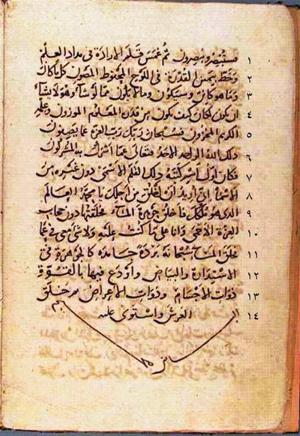
so you will see, and they will see [5]” [Qur’an 68:1–5].
Then He dipped the Pen of Will into the ink of Knowledge, and with the right hand of Power inscribed upon the protected, Preserved Tablet everything that was (the past), that is (the present), and that shall be (the future), as well as what will not be (the nonexistent, though here in a more restricted sense): how it would be if He willed it to be—although He does not will it (that is, the possible as it exists in the mind; I exclude sheer nonexistence, which cannot exist at all).[36] (The Pen inscribed all this upon the Preserved Tablet) from His known and measured determination and His noble, treasured knowledge.
Glory be to your Lord, the Lord of Might, above what they ascribe [Qur’an 37:180]. That is God, the One, the Unique; exalted is He above what the associators associate with Him.
(The Beginning of Spiritual Creation)
The first name that this Supreme Pen wrote, before all other names, was: “For your sake, Muhammad, I will to create the cosmos that is your kingdom, and so to create the jewel of water.[37] I created it on this side of the most inviolable veil of Inaccessibility, while I remained as I had been, with nothing alongside Me, in ama.”[38]
He, glory be to Him, created water as a solid hailstone, like a jewel in its roundness and whiteness, and deposited within it potentially the entities of bodies and accidents (before their actual existence).
Then He created the Throne—
Notlar
[36]
This encompasses all four levels of existence, because the Preserved Tablet contains knowledge of everything, including things that may exist potentially even though they do not exist actually. Sheer nonexistence must, however, be excluded: that which cannot exist, such as a partner to God or a square circle. It is ignorance to count what cannot be counted. On the levels of existence and nonexistence, see Chapter Six of Nazariyyat al-Jawhar al-Fard (p. ??? [reference unfinished]).
[37]
The report: “The first thing God created was a jewel. He gazed upon it with the eye of Majesty, and it melted from modesty, half of it water and half fire” ??? [The source leaves this report and its documentation unfinished.]
Many reports begin with the sense “The first thing God created …”; in reality, they agree despite their apparent differences. It is related from the Prophet—may God bless him and grant him peace—that he said: “The first thing God created was the Pen. Then He said to it, ‘Write.’ It asked, ‘What shall I write?’ He said, ‘Write the decree.’ And at that moment it wrote what would be until the Day of Resurrection” (Kanz al-Ummal, nos. 597, 15116, 15117, 15220, 15223, 15224, and others). Many other reports concern what God first created, such as the Muhammadan Light, the Throne, the Preserved Tablet, the Spirit, and the Intellect. These differing reports may be reconciled by understanding the things God created first as different names and attributes of the Muhammadan Light, from which He created everything. It is also mentioned in the Qur’an under many designations, including the Manifest Imam, Justice, “everything,” the Pen, and the Real, as in His saying: “We did not create the heavens and the earth except through the Real.” Accordingly, Shaykh Muhyi al-Din calls it “the Real through whom creation occurs” and “the Muhammadan Reality” (al-Futuhat al-Makkiyyah: vol. 1, pp. 119, 731; vol. 2, pp. 60, 104, 283, 285, 310–313, 391, 396, 415, 488; vol. 3, pp. 77, 92, 150, 354–355, 444; vol. 4, p. 211). God, exalted is He, knows best.
[38]
This alludes to the report from Abu Razin, who said: “I asked, ‘Messenger of God, where was our Lord before He created His creation?’ He replied: ‘He was in a cloud, with no air below it and no air above it, and He created His Throne upon the water.’” Uma or ama means cloud. In another reading, “He was in ama,” with a shortened final vowel, means that nothing was with Him. See Muhammad ibn Abd al-Rahman al-Mubarakfuri, Tuhfat al-Ahwadhi fi Sharh Jami al-Tirmidhi, Book of Qur’anic Commentary from God’s Messenger, chapter on Surat Hud, hadith no. 3213; see also Kanz al-Ummal, no. 29851.
Translator’s note TN11-1: “Accidents” translates arad: qualities or states that occur in a subject, rather than accidental events in the everyday sense. “Potentially” and “actually” retain the source’s distinction between what is present as a possibility and what has been brought into realized existence.
Translator’s note TN11-2: Ama is retained in transliteration because editorial note 38 distinguishes a reading associated with “cloud” from a shortened form interpreted as the absence of anything alongside God. The translation does not settle that textual question.
Translator’s note TN11-3: Numbered note 37 presents the Arabic editor’s reconciliation of reports about the first creation. Its initial report has unfinished documentation in the source; translating it does not supply an authentication.