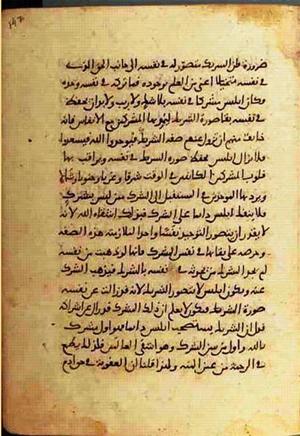
for he conceives the partner within himself beside the Real imagined within himself—I mean from his knowledge of His existence. He has not left Him alone within himself. Iblis was therefore, without any doubt, an associator within his own self.
He must preserve the form of the partner within himself so that he may supply the associators with it at every breath. He fears that the attribute of association may depart from them, so that they affirm God’s unity and attain felicity. Iblis therefore continually preserves the partner’s form within himself and, through it, watches the hearts of the associators existing at that time in the east, west, south, and north. Through it he brings those now affirming divine unity, who are not associators, into association in the future.
Iblis thus never ceases to be engaged in association. Through this God has made him wretched, for he cannot conceive divine unity for a single breath, owing to his constant attachment to this attribute and his eagerness for it to remain within the associator’s soul. Were it to depart from his own soul, the associator would find no one to speak inwardly to him of association, and association would leave him. Iblis would no longer conceive the partner, since its form had departed from his soul, and he would therefore not know that the associator had ceased his association.
This shows that the partner continually accompanies Iblis. He is the first to associate a partner with God and the first to institute association, and he is the most wretched of all beings. For this reason he hopes for mercy from sheer gracious favour. Thus we said that, in Adam’s case, the punishment
Notes
Translator’s note TN936-1: The preceding page calls Iblis an affirmer of divine unity while attributing the burden of others’ association to him. This page then locates association within his continual mental representation of a partner. Both stages of the author’s argument are retained rather than harmonized into a single assertion.