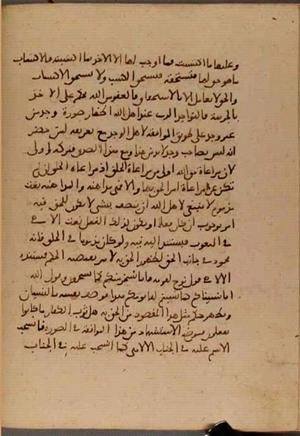
“Against it is what it acquires” [al-Baqara 2:286]. He assigned to it only being taken to task for what it acquired. Acquisition is not a right belonging to it to which it is entitled. It is entitled to earning, not acquisition. The Real deals only according to what is deserved, so God’s pardon rules over taking to task for an offense.
The invoking of ecstasy found among the people of God is displaying the form of ecstasy without ecstasy, to accord with the people of ecstasy, while informing those present that one does not possess ecstasy. This is indispensable. Even with this truthfulness, refraining is preferable, for observing God’s right is preferable to observing creation. If observing creation does not arise from observing the Real’s command to do so[42], it is flattery, and flattery is a blameworthy description.
It is not fitting for the people of God to be qualified by anything unless, if it is an act, the Real commands it as obligatory, or the act has a divine description among the descriptions upon which one may rely in it, even if it is blameworthy in creation. It is praiseworthy on the side of the Real, since the Real appears through it for a matter required by the ruling.
(Accord in Form)
Its divine support is Noah’s saying to his people, “We mock you as you mock” [Hud 11:38], and God’s saying, “Today We forget you … as you forgot the meeting of this day of yours” [al-Jathiya 45:34]. He described Himself as forgetting. The ruling of such a thing becomes manifest in the intended recipient upon whom it is brought: “Have the disbelievers been requited for what they did?” [al-Mutaffifin 83:36]. The point adduced as evidence here is accord in form.
The name thus applies to it in the divine Side as it applies to it in the Side
Notes
[42]
(“مر” was corrected to “أمر,” “command,” by comparison with the new edition.)