
Futmak · الفتوحات المكية · Meccan Revelations

The Meccan Revelations

Manuscript volume 4 · Page 276

Konya manuscript

Open Arabic sourceOpen English translation

Arabic

الضيق وأسفله الواسع. وهكذا خلقه الله، فأول ما خلق منه الضيق، وآخر ما خلق منه ما اتسع، وهو الذي يلي رأس الحيوان.

ولا شك أن حضرة الأفعال والأكوان أوسع، ولهٰذا لا يكون للعارف اتساع في العلم إلا بقدر ما يعلمه من العالَم. ثم إنه إذا أراد أن ينتقل إلى العلم بأحدية الله تعالى، لا يزال يرقى من السعة إلى الضيق قليلا قليلا؛ فتقل علومه كلما رقى في العلم بذات الحق كشفا، إلى أن لا يبقى له معلوم إلا الحق وحده، وهو أضيق ما في القرن.

فضيقه هو الأعلى على الحقيقة، وفيه الشرف التام، وهو الأول الذي يظهر منه إذا أنبته الله في رأس الحيوان؛ فلا يزال يصعد على صورته من الضيق، وأسفله يتسع، وهو لا يتغير عن حاله، فهو المخلوق الأول.

(مثال الواحد وتكاثر العدد)

أ لا ترى الحق سبحانه أول ما خلق القلم، أو قل العقل كما قال، فما خلق إلا واحدا؛ ثم أنشأ الخلق[54] من ذٰلك الواحد فاتسع العالَم. وكذٰلك العدد منشؤه من الواحد، ثم الذي يقبل الثاني لا من الواحد الوجود، ثم يقبل التضعيف والتركيب في المراتب فيتسع اتساعا عظيما إلى ما لا يتناهى.

فإذا انتهيت فيه من الاتساع إلى حد ما من الآلاف وغيرها، ثم تطلب الواحد الذي نشأ منه العدد، لا تزال في ذٰلك تقلل العدد ويزول عنك ذٰلك الاتساع الذي كنت

Notes

[54]

(صُحّحت «الحلق» إلى «الخلق» بمقابلة الطبعة الأحدث؛ والسياق في نشأة العالم عن الواحد.)
English

the narrow end and its lower end the broad end. This is how God created it. The first part of it He created was the narrow part and the last part was what broadened, which is the part next to the animal's head.

Without doubt the presence of acts and engendered things is broader. Thus the knower's knowledge has breadth only in proportion to what he knows of the cosmos. Then, if he wishes to pass to knowledge of the exclusive oneness of God Most High, he continues to ascend little by little from breadth to narrowness. His kinds of knowledge grow fewer as he ascends through unveiling in knowledge of the Essence of the Real, until nothing known remains for him except the Real alone. This is the narrowest part of the horn.

Its narrowness is truly the upper end and possesses complete nobility. It is the first part of it to appear when God causes it to grow on the animal's head. It continues to rise in its form from the narrow point, its lower end broadens, and it does not change from its state. Thus it is the first-created thing.

(The Example of One and the Multiplication of Number)

Do you not see that the first thing the Real, glory be to Him, created was the Pen, or say the Intellect as he said? He created only one. Then He brought creation forth[54] from that one, and the cosmos broadened. Similarly, number arises from one. Then what admits a second, apart from the One in existence, admits doubling and composition in its ranks, so that it broadens tremendously without end.

Once you have gone so far in this breadth as the thousands or some other limit, and then seek the one from which number arose, you keep reducing the number, and you lose the expansiveness

Notes

[54]

(Ḥalq was corrected to khalq, “creation,” by comparison with the newer edition. The context is the emergence of the cosmos from the one.)

Translator’s note TN1234-1: The narrow end is “upper” in rank, even though the broad base adjoins the animal's head. The phrase “apart from the One in existence” reflects a compressed Arabic construction also found in the Maymaniya parallel. The next page distinguishes the one considered in itself from number, which appears with two.

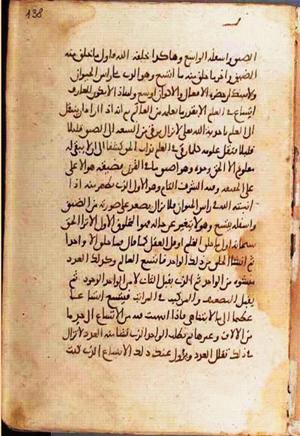
Manuscript imageManuscript volume 4 · Page 276

Arabic and English are linked by the same Konya page ID. Page alignment is approximate; consult the manuscript image for verification.

Cairo source reference

Ibn al-Arabi, The Meccan Revelations — Manuscript volume 4 · Page 276 — https://www.futmak.com/english/konya/pages.php?id=1234&text=both