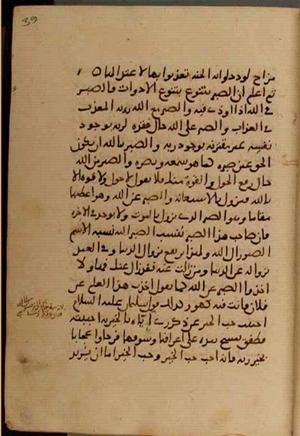
if they entered the Garden with it, they would be tormented by it because of its temperateness.
(The Kinds of Patience According to Relational Particles)
Know, then, that patience varies with the particles. Patience in God is when one is harmed for His sake. Patience with God is seeing the tormentor in the torment. Patience toward God is the state of losing one’s Lord through the existence of one’s self, unaccompanied by the existence of one’s Lord.
Patience through God is the Real’s being one’s patience itself, just as He is one’s hearing and sight. Patience from God is the state of might and power being removed from you, so that you do not say, “There is no might and no power except through God,” for it ceases through seeking help.
Patience received from God is the greatest in station. It is the patience that ceases with death and does not exist in the Hereafter. Its possessor ascribes patience to himself as the name the Patient is ascribed to God. For this reason it passes away with the passing away of this world, and in the servant with his departure from this world. Whoever you have left behind has left you behind.
(The Meaning of Patience Received from God and the Inward Application of Solomon’s Story)
These have received patience from God,[25] just as you say, “I received this knowledge from so-and-so”: you are in it as he is. Likewise Solomon, peace be upon him, said, “I loved the love of good from my Lord’s mention” [Sad 38:32]. He called it good, and good is ascribed to God. He thus said: I loved it from my Lord’s mentioning it as good.
He began stroking their manes and shins with his hand, rejoicing in and admiring his Lord’s good. He loved the love of good. This love of good may intend
Notes
[25]
(Here he interprets ʿan as taking and receiving, as one says that knowledge is taken from someone. He later states explicitly that he does not mean patience in separation from God.)
Translator’s note TN4140-1: The prepositional distinctions are fī, ‘in’; maʿa, ‘with’; ʿalā, rendered ‘toward’; bi-, ‘through’; min, ‘from’; and ʿan, rendered ‘received from.’ In the last and in Solomon’s verse, the explanation takes ʿan as reception from a source, not separation or neglect.