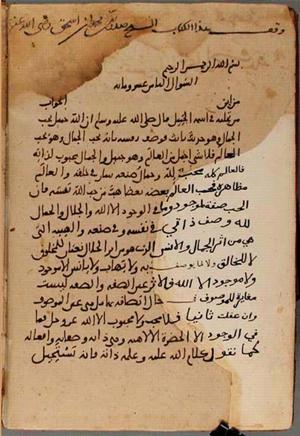
In the name of God, the All-Merciful, the Most Merciful.
Question One Hundred and Eighteen
From where?
The answer
From His self-disclosure in His name the Beautiful. He, may God bless him and grant him peace, said, “God is beautiful and loves beauty.”
This is an established report. He described Himself as loving beauty, and He loves the world, so nothing is more beautiful than the world. He is beautiful, and beauty is loved for itself. The whole world therefore loves God, and the beauty of His workmanship permeates His creatures. The world is His loci of manifestation, so the world’s parts loving one another sprang from God’s love of Himself[1].
Love is an attribute of an existent, and there is none in existence but God. Majesty and beauty are God’s intrinsic description, in Himself and in His workmanship. Awe, which is an effect of beauty, and intimacy, which is an effect of majesty, are two descriptions of the creature, not of the Creator or what He is described by. Only an existent feels awe or intimacy, and there is no existent but God. The effect is therefore the very attribute, and the attribute is not different from the one qualified by it while he is qualified by it; rather, it is the very one qualified.
Even if it is understood as a second thing, there is no lover or beloved but God, mighty and majestic. Nothing exists but the divine presence: His Essence, attributes, and acts. As we say, God’s speech is His knowledge, and His knowledge His Essence, for it is impossible
Notes
[1]
(The newer edition establishes habba, “sprang,” in this passage, and the main text is vocalized accordingly. It is not a conjectural correction here of huwa, “he/it is.”)
Translator’s note TN3757-1: The source assigns awe to beauty and intimacy to majesty in this order. That pairing is retained. The opening question continues the preceding discussion of the drink of love.