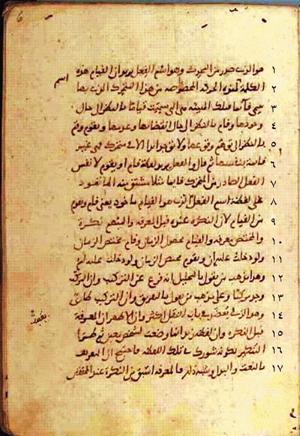
that it is what issues from the originator. It is the name of the act: that is, the word qiyām, “standing,” names this particular movement of this moving being, who is called “standing” because of it. That configuration is called qiyām, “standing,” with regard to its state of existence; qāma, “he stood,” with regard to its having passed and ceased to exist; and yaqūmu, “he stands or will stand,” and qum, “stand!”, with regard to its imagined occurrence. It never exists except in a moving being, and so does not subsist through itself.
He then said, “The verb”—meaning the expression qāma or yaqūmu, rather than the act itself issuing from the moving being who is, for example, standing—“is derived and taken from it.” The pronoun “it” refers to the expression naming the act, namely qiyām. He means that qāma and yaqūmu are taken from qiyām, because, in his view, the indefinite precedes the definite. The unspecified is indefinite, and the particularized is definite. Qiyam has an unknown time; qāma has a specified time, even if preceded by in, “if”; and yaqūmu has a specified time, even if preceded by lam, “did not.”
This is the view of those who hold that analysis is derived from composition and that the composite came into existence already composed. As for the view of those who affirm separation and hold composition to be supervening—this is more strongly supported by transmitted usage.
For what is more evident is that the definite precedes the indefinite. The expression “Zayd” was initially assigned to a particular individual. Indefiniteness then supervened because others shared that expression, so specification was needed through an adjective, an apposition, or the like. According to the people of realization, the definite precedes the indefinite.
Notes
Translator’s note TN332-1: Ism al-fiʿl here is explained by the passage itself as the “name of the act,” qiyām; it is not being used for the separate grammatical class often called “verb-nouns.” The remarks about in and lam preserve the author’s argument concerning temporal specification, although these particles affect how the verb’s time is understood. The transition between the two views of composition and separation is elliptical in the supplied text.