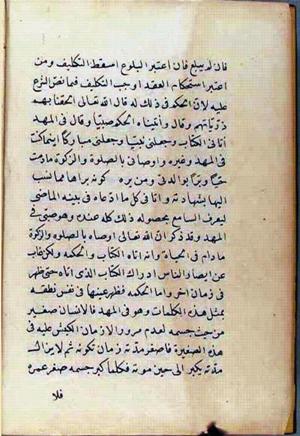
even if he has not reached maturity. Whoever takes maturity into account removes the obligation. Whoever takes the full establishment of reason into account imposes obligation in what the Law expressly states, for the ruling belongs to it. God, exalted is He, says, “We joined their offspring to them[2],” also read “their descendants” [al-Tur 52:21]. He says, “We gave him judgment as a child” [Maryam 19:12]. The one in the cradle said, “He has given me the Book and made me a prophet, and made me blessed wherever I am” [Maryam 19:30, 31], in the cradle and elsewhere, “and enjoined prayer and almsgiving upon me as long as I live, and kindness toward my mother” [Maryam 19:31, 32].
Part of his kindness to her was clearing her of what was ascribed to her by his testimony.
In everything he claimed, he used the past tense to make the listener know that he possessed all of it while a child in the cradle. He mentioned that God, exalted is He, had enjoined prayer and almsgiving upon him as long as he lived, and that He had given him the Book and wisdom. Yet the Book he had been given remained beyond the perception of people’s eyes until it appeared at another time.
Wisdom itself appeared in his speaking such words while in the cradle.
A human being is small with respect to his body because few periods of time have passed over him in this form. His shortest duration is the time of his formation. His duration then continues to grow until his death.
As his body grows, the life left to him diminishes,
Notas
[2]
(The text gives both “their offspring” and “their descendants” in presenting the reading. Both forms have been retained as they appear in the newer edition.)
Translator’s note TN2529-1: The source gives both dhurriyyatahum and dhurriyyātihim, collective offspring and plural descendants. The sequence then brings together the child given judgment and the speech of Jesus in the cradle.